
Los Alamos Parole and Probation
Parole and probation can both place a person under the New Mexico Corrections Department Probation and Parole Division, but they begin in different ways. The New Mexico Parole Board decides parole release from state prison. NMCD field officers then supervise a person in the community. A sentencing court orders probation, often with a deferred or suspended part of a sentence. Pretrial release, bond, and electronic monitoring before judgment are separate again. Those court controls do not by themselves make someone an NMCD probationer.
The distinction matters in Los Alamos County because the Los Alamos Police Department Detention Center holds pretrial detainees, short local sentences, and temporary holds. Leaving that center may end physical custody with no NMCD supervision. A state-prison release to parole remains within the NMCD system. The comparison below identifies the records that carry the most weight.
| Question | Parole | Probation |
|---|---|---|
| How it begins | Release from state prison under parole authority | Order entered by the sentencing court |
| Decision source | New Mexico Parole Board decision | Judgment, sentence, or later court order |
| Field supervision | NMCD Probation and Parole Division | NMCD Probation and Parole Division when state supervision applies |
| Best current check | NMCD Offender Search plus assigned office | NMCD Offender Search plus court docket |
| Best final record | Board decision and supervision discharge record | Court discharge, completion, or revocation order |
A current result can show supervision now. It may not explain the prior Los Alamos detention episode. For the local release event itself, use the Los Alamos County released-inmate search and record path to obtain the LAPD custody movement and controlling court order.
- Parole
- Community supervision during the remainder of a state-prison sentence after release under parole authority.
- Probation
- Court-ordered supervision that may replace or follow a suspended part of confinement.
- Discharge
- The formal end of a supervision term, shown by the responsible agency or court record.
- Absconder
- A supervision label indicating lost contact or failure to report. It is not proof of a new conviction.
Verify Los Alamos Post-Release Supervision
The official starting point is the NMCD Offender Search. Use the NMCD number when known because it separates people with similar names. The direct search offers Active, Include Inactive, and Absconder Only choices, along with region and age filters. Select Include Inactive when checking a supervision term that may have ended. An Active-only search is not a sound historical test.
NMCD says its probation and parole information updates in real time, while prison information updates nightly. A status move from incarceration to parole supervision is a strong operational sign of release from state prison. It still does not establish the exact gate time, settle every hold, or prove departure from the Los Alamos Police Department Detention Center.
- Match the legal name, NMCD number, age, and any other displayed identifier. Do not rely on a shared name.
- Read the status exactly. Note whether it says incarceration, parole, probation, inactive, or absconder, and record the search time.
- Open the New Mexico Judiciary Case Lookup and find the correct Los Alamos case. Compare the judgment, probation term, violation filings, and discharge or revocation orders.
- Use the NMCD Probation and Parole directory to verify the current district or office. Office assignments can change.
- If the records conflict, give the clerk or supervising office the case number and NMCD number. Ask which public record reflects the current status.
Some information remains private. Field staff may confirm the district, office, or a public warrant status, but they should not be expected to disclose a home address, treatment details, victim information, or a full supervision plan. A precise request gets a more useful response.
Los Alamos Parole Hearing Records
The New Mexico Parole Board makes parole decisions. It is an independent agency administratively attached to NMCD, not the same office as the Probation and Parole Division that performs field supervision. The Board reports roughly 300 individual hearings each month, held weekly at correctional facilities. Those person-level hearings are closed, apart from the statutory victim-participation exception. Quarterly public Board meetings are different and should not be presented as an inmate hearing calendar.
The official Board page explains that distinction. It also places the decision process in its correct role before any NMCD field-supervision check.
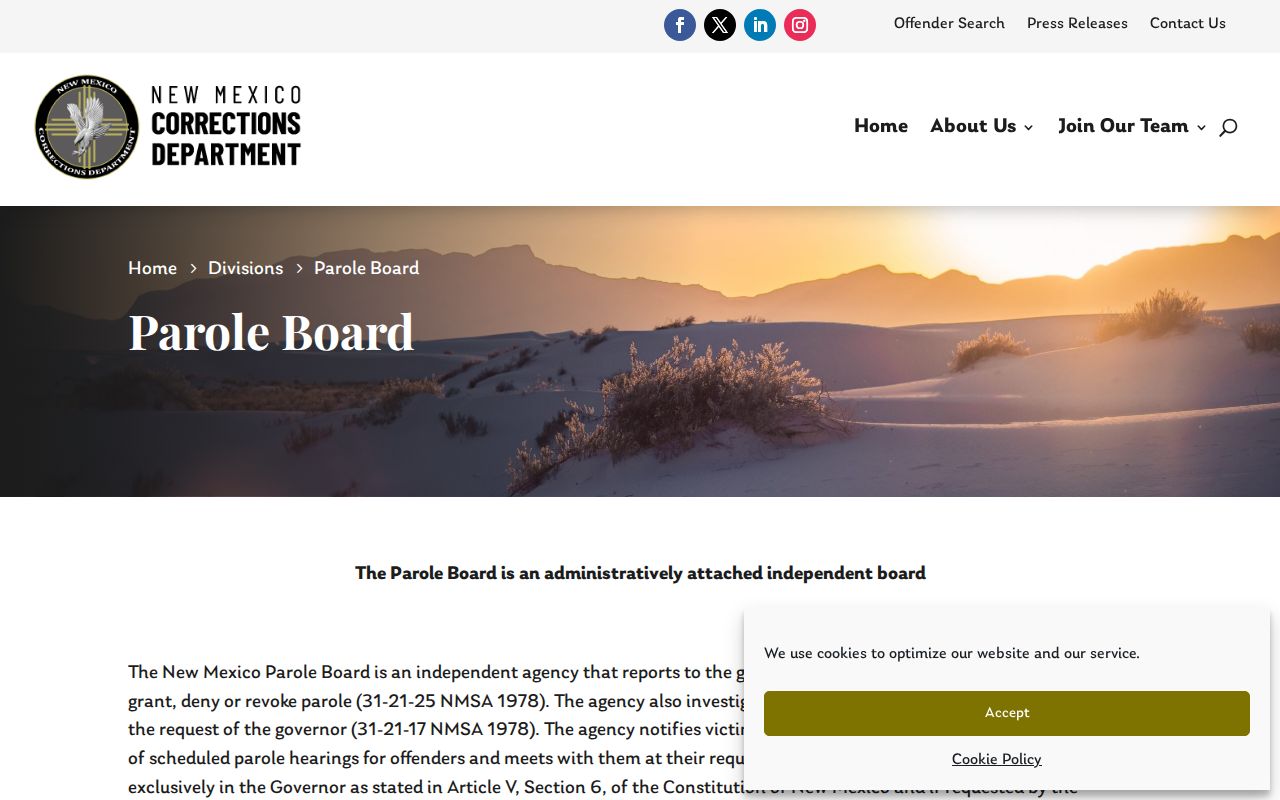
The image helps separate closed individual hearings from public policy meetings. No official public person-name hearing calendar or decision database was identified. For a named hearing, match the person, NMCD number, institution, hearing type, and date, then request the final decision from the Board Records Manager when public access permits.
New Mexico Parole Board Records
Board Records Manager
4337 State Road 14
Santa Fe, NM 87508
505-827-8853
Use the Board's exact outcome wording, which may state approved, denied, deferred, continued, rescinded, or no action. A hearing date does not prove release. Even a favorable result can remain subject to an adequate parole plan, conditions, detainers, and release processing. Current state law, as amended in 2026, generally places parole eligibility for a life sentence at 30 years, with separate youthful-offender provisions; life without possibility of release or parole remains ineligible. Ordinary determinate, sex-offender parole, and youthful cases follow other rules. Eligibility is never the same as physical release.
Los Alamos Supervision Office Route
Los Alamos County falls within NMCD's northern District 1 structure. The official directory is the safe source for a current assignment because reporting sites and officer assignments can change. A 2025 New Mexico Judiciary community-mapping report adds a practical local detail: felony probation and parole work for Los Alamos is run from Española. Officers make local home checks, while office visits may require travel to Española.
NMCD Probation and Parole Division
Service area: District 1, including Los Alamos County
Local reporting context: Española office travel may be required
Confirm the assigned office in the NMCD directory
Confirm before making the trip. Ask which office holds the case, whether an appointment is in person, and which public identifier staff need. The supervising office can establish a current operational assignment. The court clerk remains the source for filed probation orders and later court action.
Los Alamos Absconder Record Checks
An Absconder Only search option can narrow the NMCD public system, but the label must be handled with care. Absconder usually means the agency reports that the person stopped reporting or cannot be located under the supervision terms. It does not show that a court has proved a new offense. A warrant may exist, yet a search label alone should not be converted into a claim about the warrant's scope or current validity.
No county-published Los Alamos parole or probation absconder list was identified. Check the NMCD result, then examine the filing court's docket for a warrant, violation report, revocation motion, or later order. The First Judicial District serves Los Alamos district matters. Municipal or Magistrate records may hold other local case pieces, depending on jurisdiction. If a public docket and NMCD disagree, verify with both offices using the exact case and offender numbers.
Los Alamos Supervision Notification Limits
New Mexico VINE serves custody-event notice, not a full probation or parole case log. An NMCD VINE alert can report supplied events such as release, out to court, or escape. It should not be used to infer that probation ended, that a violation was filed, or that a person was discharged from field supervision. Those facts belong in the NMCD supervision result and the court or agency record.
Likewise, the state sex-offender registry and Los Alamos OffenderWatch route cover only people who have a legal duty to register. They are not general parole or probation lists. A registry result cannot establish when a supervision term began or ended. Keep each system tied to its stated purpose, especially when similar names appear.
New Mexico public-record rules also allow limits and redactions for protected material. Request an existing status, discharge, decision, or filed order with the case and NMCD numbers. Do not ask an office to create an analysis it does not keep. When a public record is sealed, expunged, or withheld under an applicable rule, respect that access limit and avoid treating online absence as a custody fact.
Los Alamos Supervision Discharge Records
Supervision ends through a formal record, not merely because a name vanishes from an active search. For probation, look for a court order or certificate showing completion, early discharge, revocation, or another disposition. For parole, seek NMCD supervision status and the final discharge record. New Mexico's statewide functional schedule treats parole and probation files as permanent, with archival transfer after completion under the schedule described in the research. Online visibility can still change.
Use Include Inactive for an older NMCD search. Then compare the result with the filed court record. Expunged, sealed, or otherwise protected material may no longer be open to the public, so an empty result is inconclusive. The sound historical statement comes from an agency or court record tied to the right person, case, and term.
Conditions and violations also affect how a term ends. A court can revoke probation, modify it, or discharge it. Parole action can change the supervision status and may return a person to custody. Record each source date, since an NMCD real-time status can move before a later order is easy to locate in the docket.
Los Alamos Release Reentry Gap
The 2025 New Mexico Judiciary community-mapping report found that help after detention release was informal and that stakeholders identified no dedicated Los Alamos resource for people leaving custody. That finding is more specific than a broad claim that local reentry services exist. It also explains why the Española reporting trip can create a real gap between release and stable compliance.
People under felony supervision may receive home checks in Los Alamos but still need to travel for office visits. Confirm the assigned office, appointment method, and reporting deadline before arranging transportation. The LAPD Detention Center can answer facility routing questions, but it is not the NMCD field office and does not decide parole. Clear agency roles help prevent a missed report after release.
Note: A local detention release, NMCD parole decision, and first field-office report are separate events that may occur on different records.